BlinkTrace · Independent Deepfake-Detection Research System
The benchmark is not the deployment.
Deepfake detectors that look strong on curated datasets can fail on a real webcam — because they learn capture-pipeline shortcuts, not manipulation cues. BlinkTrace studies what actually survives: layered forensic signals — appearance, facial geometry over time, motion stability, texture and frequency artifacts, pulse-consistency cues — under leakage-aware, deployment-matched evaluation.
recognition

The BlinkTrace research earned an invitation to an innovation UBC cohort.
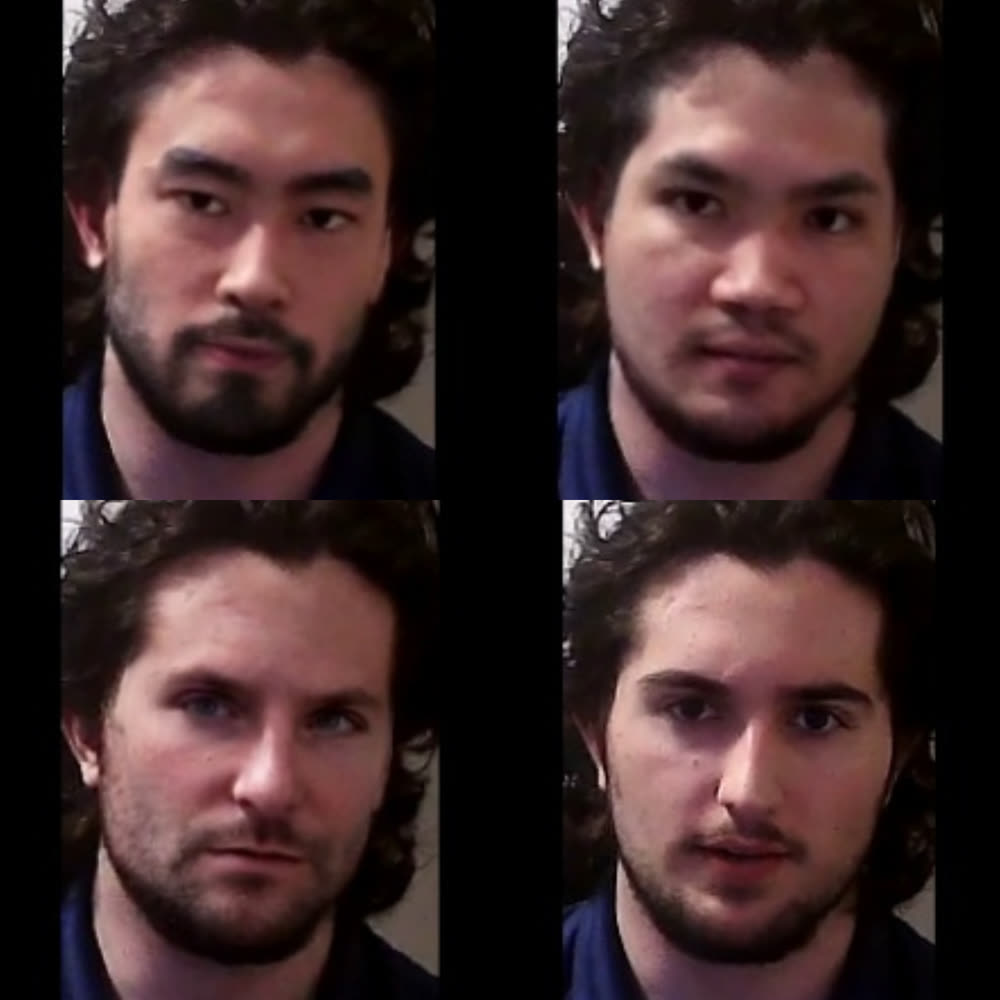
specimen · matched session crops
One of these four crops is real. The other three were generated from the same session.
Three manipulated crops and one real one, matched from a single capture session — the granularity BlinkTrace evidence operates on, and exactly why single-frame judgment is not enough.
01 · the pipeline
Watch a video become a verdict.
What follows is an illustrative analysis flow — an example forensic workflow showing the layered signals BlinkTrace reasons over, from raw webcam capture to a fused decision. Representative of how the system thinks, not a blueprint of the production pipeline. Scroll to run it.
stage 01 — Media intake
Media intake
A talking-head video arrives the way the real world sends it: webcam-compressed, white-balance shifted, re-encoded along the way. This is the domain where benchmark-strong detectors quietly fail.
02 · system architecture
Not one model. Layered families of evidence.
BlinkTrace pairs two current core learned branches — an EfficientNet-B0 spatial CNN and a landmark-dynamics GRU joined by late fusion — with exploratory forensic layers in motion, frequency and biological-signal space. Every family runs under the same deployment-aware protocol, so when one wins, the result says something about the signal — not the split.
Illustrative signal flow. Exploratory layers are evaluated as candidate fusion inputs; they join the decision path only when they add robustness under webcam-matched evaluation.
EfficientNet-B0 spatial branch
A compact EfficientNet-B0 backbone over tracked 224×224 face crops, pooled and read out by an MLP head. The strongest baseline under held-out generation families — and the most sensitive to white-balance, encoding and crop shortcuts, which is exactly why preprocessing controls matter.
x → EffNet-B0 → GAP → MLP → p_cnnLandmark-dynamics GRU
A GRU over normalized 478-point landmark sequences with motion made explicit — position, velocity and acceleration at every timestep. Scientifically informative but weaker than appearance under generator shift: a finding the research treats as evidence, not failure.
L_t = [x̂_t, v_t, a_t] · h_t = GRU(L_t, h_(t−1))Late fusion
Video-level CNN and GRU confidence are combined by a lightweight fusion layer, evaluated for operating-point stability as much as for ranking. Fusion that improves decisions without improving AUC is reported as exactly that.
p_final = fusion(p_cnn, p_gru)Motion inconsistency
A priority research direction beyond the learned baselines: optical-flow fields, codec motion vectors and facial micro-jitter statistics on tracked crops — frame-to-frame synthesis instability that sanitized landmark meshes smooth away.
φ = stats(flow_{t→t+1})Texture / frequency
Lightweight transform-domain descriptors — LBP, DCT band energies, radial FFT statistics — probing for over-smooth synthetic skin and spectral irregularities that survive compression and color controls.
ψ = [LBP, DCT, FFT](crop)Pulse consistency
An rPPG-inspired biological-signal check over 5–10 second windows: do skin-tone rhythms in forehead and cheek regions show plausible pulse periodicity? A corroborative signal for longer-window assessment, never the primary detector.
r = rPPG(ROI_{1..t}) · periodicity(r)03 · evaluation philosophy
Near-perfect accuracy is a warning sign.
In deepfake detection, the fastest way to a great number is a broken split. BlinkTrace treats suspiciously easy results as bugs to explain, and holds every experiment to leakage-aware, source-matched evaluation.
Frame leakage
01Random frame splits put frames of the same video on both sides. Accuracy jumps past 99% — the model memorized content, not manipulation.
split(frames) ⇒ AUC ≈ 1.0 ⚠Identity leakage
02The same person in train and validation lets the model learn faces and lighting instead of forgery cues.
id(train) ∩ id(val) ≠ ∅Generator leakage
03Seeing a generation method in training means detecting its fingerprint, not deepfakes in general. Held-out families are the honest test.
gen(train) ∩ gen(val) ≠ ∅Encoding shortcuts
04Compression, white balance and crop composition differ systematically between real and fake sources — models happily score the codec. BlinkTrace counters with re-encoding and compression-jitter controls at train and evaluation time.
epoch-1 AUC → 1.0 on held-out gen ⚠how much should you trust a validation number?
data tracks
FaceForensics++
public benchmarkA canonical deepfake benchmark used in BlinkTrace research for controlled evaluation, matched-pair analysis, and cross-method comparison.
DeepSpeak
public research datasetA public research dataset used in BlinkTrace experiments for generator-diverse synthetic media analysis and broader model evaluation.
DeeperForensics-1.0
public datasetA large-scale deepfake dataset with real-world perturbation conditions, used in BlinkTrace research for robustness-oriented evaluation and pretraining context.
Celeb-DF
public datasetHigh-quality face-swap videos designed to be more challenging than earlier benchmarks, used when assessing robustness against cleaner, more convincing manipulations.
WildDeepfake
public datasetFace sequences collected from in-the-wild internet videos, useful for checking how detection signals behave under uncontrolled, real-world distribution shift.
Deepfake Detection Challenge Dataset
public datasetOne of the largest public deepfake corpora, spanning thousands of actors and multiple manipulation methods — a scale and diversity reference for cross-dataset comparison.
WebcamBench
proprietary capture trackBlinkTrace’s internal structured-capture dataset for webcam-style deepfake research, built around guided sessions, real/fake pairing, and deployment-relevant evaluation conditions.
04 · structured capture
Evaluation data is captured, not scraped.
BlinkTrace runs a private, consent-based capture portal: structured webcam sessions with scripted prompts, timed blocks and motion guidance. The result is matched real/fake evaluation data from the exact capture path the system defends — the part of the pipeline most benchmarks cannot offer.
session progress: 37%
scripted block b
Read the prompt aloud
Say twice: “a short calibration phrase appears here during live sessions.”
Keep your face centered and avoid other faces entering the frame.
session: bt-•••-••• · 2026-07-09T••:••Z · id redacted
Interface shown is representative. The full capture protocol — prompt sets, block structure and timing — remains internal to the research program.
Timed session blocks
01Each session runs a guided multi-minute protocol of short blocks — scripted reading, free speech, guided micro-motion — so every capture covers the temporal behaviors the forensic layers need.
Scripted prompts
02Participants read controlled phrases aloud on a timer. Scripted speech gives matched lip, jaw and blink dynamics across participants without constraining natural motion.
Deployment-identical path
03Capture runs through the same web-portal, webcam and encoding path the detector is evaluated on. No lab cameras, no clean studio footage — the data looks like deployment because it is the deployment path.
Matched real/fake pairs
04Hard generated fakes are produced from the same sessions, so every real clip has a matched synthetic counterpart under identical capture conditions — the backbone of webcam-matched evaluation.
05 · autonomous research layer
The routine work runs while nobody is watching.
The orchestration layer is not an autonomous scientist — it clears the runway. Agents handle the repeatable substrate of the research: preprocessing datasets for training, standing up holdout splits per generation method, launching and monitoring jobs, and logging every artifact to disk. A research agent then surveys the results and proposes thesis-aligned directions worth investigating. The hypotheses, experiment design, interpretation and conclusions stay with the researcher.
agents handle
the researcher keeps
launch
worker agents start routine preprocessing, holdout-split and training jobs
poll
cheap cron cycles check progress; running stages exit fast
artifacts
structured markdown and JSON written locally for every stage
research review
a research agent summarizes results and suggests thesis-aligned follow-ups — proposals, not decisions
master review
a master agent checks each proposal against the thesis for drift
integrity gate
protocol and data-health checks can block, waive, or pause the chain
continue only if status ∈ { pass, scoped_risk_continue } — otherwise the chain pauses for review
07:12:04stage launched — motion_flow_jitter_matched_pairs
07:12:05polling on cron · exit_running
07:48:19stage complete · artifacts written (markdown + json)
▊
statuses: running · paused_for_review · scoped_risk_continue · blocked
06 · the paper
Practical deepfake detection under real webcam conditions.
BlinkTrace treats deepfake detection as a representation problem under generation shift, not a closed-set classification problem. Detectors that look strong on curated benchmarks turn fragile in real time — the moment the generation family, encoding path, or capture conditions change. The forensic signals that survive that shift are the ones worth building on.
preprint status
The paper is in preparation and will be posted as a preprint on arXiv.
contribution framing
- (i)
Show that detection performance can degrade or mislead under real webcam conditions even when offline results look strong.
- (ii)
Identify shortcut learning — from encoding, white balance, crop composition and generator fingerprints — as a primary failure mode.
- (iii)
Evaluate spatial CNN, temporal GRU and fusion pipelines under identical deployment-matched conditions, with leakage-aware splits throughout.
- (iv)
Introduce a webcam-matched evaluation setup built from real sessions and hard generated fakes captured through the same portal path.
- (v)
Present a practical scoring protocol: tracked crops, gray-world normalization, intro-frame skipping, and robust video-level aggregation.
claims this work refuses to make
- ✕that deepfake detection is solved
- ✕that one architecture generalizes to all generators
- ✕that fusion proves multimodal complementarity
- ✕production readiness from a small evaluation set
what the evidence supports today
A compact CNN with leakage-aware evaluation and shortcut mitigation generalizes meaningfully — but deployment-like webcam conditions reveal instability that benchmark-style reporting hides. The next gains come from better signal choice, not bigger networks.